“Never cry over spilt milk, because it may have been poisoned.” W. C. Fields


There’s almost no one in the world who doesn’t know it. That liquid, creamy joy that’s accompanied us since birth - whether with our morning granola, as the essence of a foamy latte, or a pure delicious side to freshly baked cookies. Cleopatra poured it in her bathwater thinking it would keep her skin eternally youthful. “Milk is full of calcium, it’ll make you big and strong,” or so we’ve heard since before we could even give voice to its name. Known the world over and accepted for centuries as one of the foundations of our food pyramid, today milk is more controversial than ever. A peek in the office refrigerator is enough to witness it for yourself - fighting for the pole position are rice, soy, skim, almond, and lactose-free alongside the universally known whole milk. One discovers the exact debate surrounding milk rather quickly - all of these varieties have their own benefits and disadvantages.

See our little milk overview & additional photography by the amazing photo studio severafrahm after the jump. 


 Rice Milk

Rice milk is a type of grain milk made from rice. It is commonly unsweetened; the sweet taste originates from a natural enzymatic
process, in which the carbohydrates are split into sugars.

Benefits
Rice milk is the most hypoallergenic of all milk products. Rice milk contains a generous supply of balanced nutrients.
Rice milk has the least amount of fat in comparison other types of milks. There is only one gram of unsaturated fat per cup. Rice milk is a good source of B vitamins, which are essential to metabolism.
Drawbacks
Rice milk is highly starchy. One cup of rice milk contains 33 grams of carbohydrates, three to four times the amount in cowor soy milk. For persons with diabetes rice milk can cause a sugar overload. Rice milk has little protein in comparison to cowor soy milk. Many find it to be less satisfying in taste and ineffective for appetite control. It contains almost no calcium, aside from brands that contain artificially added calcium.


Almond Milk

Almond milk is made from ground almonds. It does not contain any animal products, making it suitable for vegans and vegetarians.
Vanilla and chocolate flavors are often added, as well as sweeteners.

Benefits
Almond milk is a good source of the antioxidant vitamin E, which can prevent cancer and has been shown to help slow the signs of aging. Almond milk contains no cholesterol and no saturated fats, so it won’t harm your cardiovascular system. Compared to cow or soy milk, almond milk has the highest concentrations of vitamins and minerals. All of the nutrients, which are added to other milk varieties, occur naturally in almond milk. Almond milk is very low in calories and contains only about three grams of healthy fat per serving.
Drawbacks
Feeding almond milk to infants may cause tree nut allergies to develop. Processed almond milk may also contain unwanted additives and sweeteners. It is very dangerous for those who have even a light tree nut allergy.


Long-Life/Ultra High Temperature Milk

While fresh (pasteurized) milk is heated to 74°C for 15 seconds, long-life milk is super heated to 140°C for two seconds
and then packaged in a completely sterile environment.

Benefits
Long-life milk can be stored for months. It is easier to digest than fresh milk. In long-life milk pathogenic microorganisms are already destroyed. UHT milk is cheaper.
Drawbacks
Due to the heating process important vitamins are lost. The taste is weak in comparison to fresh milk. The loss of lactic bacteria makes it hard to notice when the milk is spoiled.


 Lactose-Free Milk

People who lack the enzyme lactase cannot digest lactose, the milk sugar. Based on human evolution almost 75 percent of the
world’s population is lactose intolerant. In lactose-free dairy products the milk sugar is already split into the two primary sugars,
dextrose and galactose, mostly by adding the enzyme lactase.

Benefits
Because of the sweetness of lactose-free milk extra sugar isn’t necessary, for example in coffee.
Drawbacks
Lactose-free products may contain unwanted additives, preservatives, and acids.

PHOTOS: severafrahm
RETOUCHING: Mladena Celik
TEXT: Zsuzsanna Toth 


SO LONG AS YOU HAVE FOOD IN YOUR MOUTH, YOU SOLVED ALL QUESTIONS FOR THE TIME BEING. (Franz Kafka)


We all know it, no one shares it:
 The necessity of letting ourselves be taken by our cravings sometimes. 

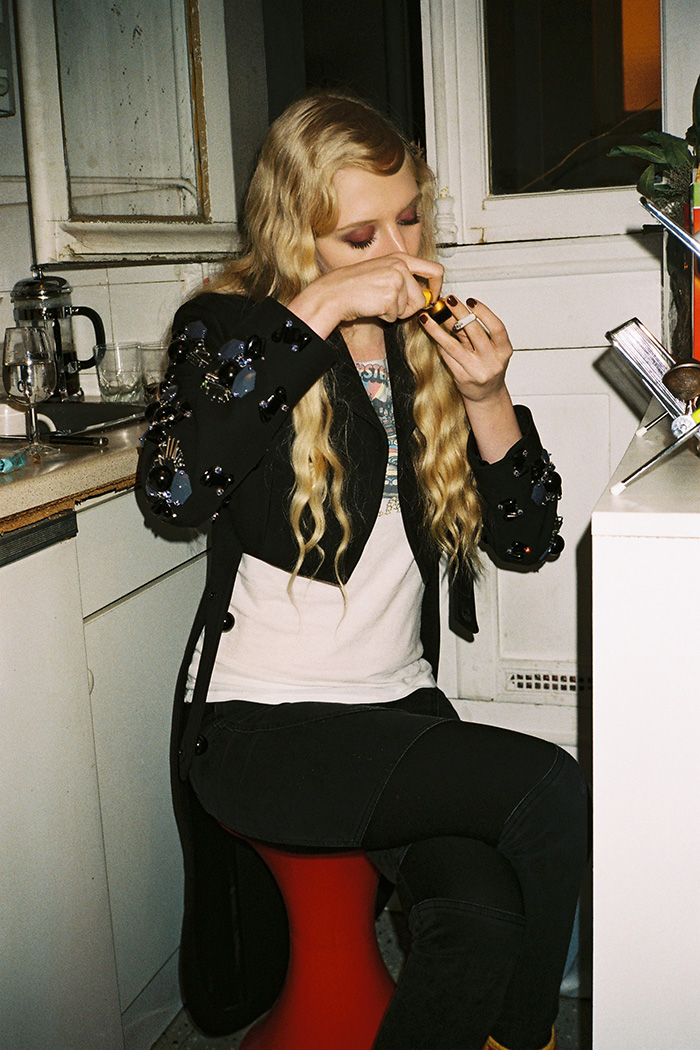
Photographer and I LOVE YOU MAGAZINES good friend Adrian Crispin and stylist Ann-Kathrin Obermeyer provided this wonderful photo series for THE DIET ISSUE. The talented duo captured the sweet moments of weakness, accompanied by all the complaining phrases we should swallow aswell. 

See our cover story after the jump. 


 "Once on the lips forever on the hips."


 "Really ? You ate a whole bar of chocolate yesterday?"

"Im gonna have to walk this off later."

“Well, it’s midnight. Technically your body doesn’t know whether it’s today or tomorrow."


"Hey, I think I'll skip the dinner if we're having drinks later."


PHOTOS: ADRIAN CRISPIN
FASHION: ANN-KATHRIN OBERMEYER
HAIR: KATSUKO KITAOKA @ SYBILLE KLEBER
MAKE-UP: MICHELLE RAINER FOR ELLIS FAAS COSMETICS 
MODEL: JORDIN GRAYE @ MARILYN AGENCY PARIS 
FASHION ASSISTANT: CHARLÖTTE CARGNELLO  
SPECIAL THANKS TO THE BdL


THE DARWIN DIET BY ELLE MULIARCHYK


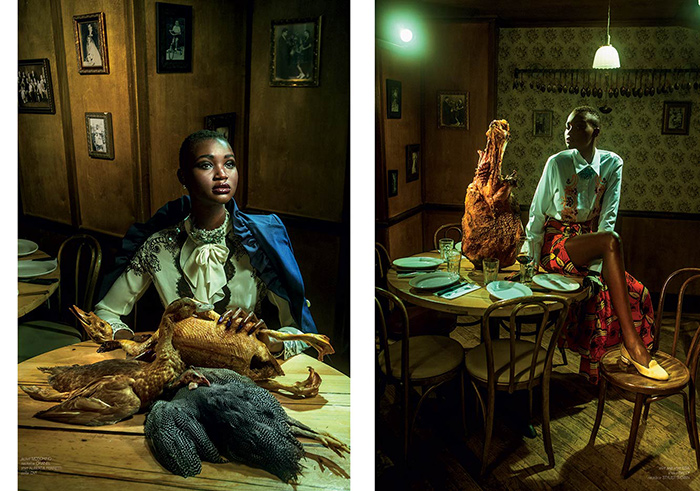
Photographer Elle Muliarchyk captured a fashionable transformation of what is called "The Darwin Diet" based on the fact that Charles Darwin used to eat every living animal crossing his way. 

This shooting took place at the Sauce Restaurant in New York City. Read what the Restaurant's chef has to say about food photography and the difference between taste and reality after the jump. 


My family traveled around the world and I grew up on the Darwin Diet, which involves eating and tasting every living creature in nature. (Apparently Charles Darwin was so keen on tasting the species he discovered that while he sailed back
to England he ate 48 rare tortoises that were meant to be “donated to science.” He also liked armadillo and puma. While he was a student at Cambrige University he was an enthusiastic member of the Gourmet Club formed by a small group of friends. Know as the “Glutton Club,” they met once a week to sample meals not found on menus, including hawk, bitten, and an “indescribable” old brown owl. Not too far behind Darwin, I ate brains of just-killed monkeys and pizzettes topped with scorpions in Vietnam. In Indonesia I tried birds’ nest soup, which is made of the bird’s saliva, sticks and pieces of dirt. We hunted wild boar in Belarus and ate its tongue, heart, and made blood sausages using the intestines. I went to Robinson Crusoe camp in the Baltics where I learned how to tenderize my leather shoes and belt, cut them into paper-thin slices, and eat them for survival. I loved learning about the these crazy diets and the cultures they come from. But at 16 years old “Diet” acquired a different meaning to me. I came to the U.S. and became a model. I ate celery sticks, almost exclusively, for the next eight years while discovering Atkins, Okinawa, Raw, Glycemic Index, Blood Type, and Microbiotic diets. For the first time in my life I saw people treating diet as a fashion trend and status symbol.

Elle


"All food photography is a lie, so it helps to start shooting with some basic truths. Chefs create three dimensional art for all five senses. A photo speaks only with two dimensions, leaving the rest up to the viewer's imagination. Many don't realize that half of taste is expectation based on what they see. Most cannot name a single flavor without their vision, yet they have no idea how their food visually starts out.

When we shot this series, we began with the Sauce concept of honoring whole animals and practicing total utilization. We then thought of how to represent it and bring it into the collective visual memory of every eating experience.

Our food usually comes to us in unrecognizable parts—parts that we cannot usually trace. The whole, on the other hand, tells us everything we need to know. It visually and emotionally connects us with our prey. Some parts are recognizable only when seen in their full context. The world often lies to us through partial presentation that, in reality, can only be understood as a whole.

I feel this shoot is a very important metaphor for what should always be seen, prepared, and evaluated as a whole: our food."


Chef Frank Prisinzano at Sauce Restaurant NYC. 


Photos: Elle Muliarchyk (blog, films 
Fashion: Sarah Cobb
Make-Up: Munemi Imai @ The Magnet Agency
DP: Rod Lamborn
Model: Ataui Deng @ Trump
Manicure: mary sol inzerillo @ cloutier remix
Chef: Frank Prisinzano @ Sauce Restaurant
Octopus by Stephen “octoman” Fried @ Gullo specialty foods


TASTY LOVERS: DOMINIC HAYDN RAWLE & URSINA GYSI


Dominik Haydn Rawle and Ursina Gysi are constantly chased by street style photographers. Originally from Switzerland and England/Australia the young couple has a strong sense for outstanding style.

For I LOVE YOU NO.09 Ursina and Dominik portrayed each other from their own unique perspectives. Moreover we talked about food rituals and favorites and asked them to share their yummiest recipe.


Where are you from?
Ursina is from Chur, Switzerland and I was born
in Tunbridge Wells in England but grew up for the
most part in Manly, Australia.

What’s your favorite meal?
Rendang, Salt and Pepper Crab, Sylvia`s Buah
Keluak, and the Mackerel Menu at Natori.

Which are your favorite restaurants from around the globe? 
Friends Corner, Zürich for the Kottu Roti 
and Dried chilis.
Eichhörnli, Zürich for Züri Geschnetzeltes.
Rheinfelder Bierhalle, Zürich for the Jumbo Schnitzel.
And the Restaurant Kronenhalle.
East Coast Seafood, Singapore.

Sami`s, Singapore. Le Martel, Paris.
Aux Deux Amis, Paris.
Le Chateaubriand, Paris.
Butcher on Sundays for roasted lamb 
on the corner of rue du Faubourg du Temple 
and rue Saint-Maur, Paris.

Fiore, Brooklyn.
Bozu, Brooklyn.
Zaitzeff Burgers, East Village.
Natori, St. Marks Place.
Omen in Soho.

Did you ever follow a specific diet?
Yes, juice, citrus, and protein.

Is there something you would never eat?
1000 year eggs, Durian, and various different
kinds of soy because they taste fucking awful.


Whats your favorite food?
D: Limes.
U: Vegtables, fish, and yogurt.

Which products end up regularly in your
shopping basket?
Ginger, dried fish, eggs.

What do you like to snack when you wake up
hungry at night?
D: Water.
U: Actually this never happens to me.

Do you have food rituals ?
U: My breakfast is
Bircher muesli with
fruits and yogurt every morning. 


Spicy Lentil Soup

2 cups of green lentils well washed
In winter add 2 sweet potatos, 
in summer add
2 chopped eggplants
4 large red onions chopped
8 big cloves of garlic diced
3 thumbs of ginger diced
4 over ripe limes
fish sauce to taste
light soya to taste
chilli powder to taste
black pepper to taste
fish curry powder to taste
1 can of coconut milk
1 large bunch of parsley washed
crème fraîche or sour cream

Brown onions in a large very hot saucepan while
lentils soak in luke warm water. When onions are
almost brown add garlic and ginger. Warm some
water, add curry and chilli powder to it, as much
as you can handle. When onions, garlic, and
ginger are good and brown, rinse off the lentils,
add them and the simmering water 
to the large saucepan.

Let this cook down for 20 minutes, then add soy,
fish sauce, and the juice of one or two limes.
Cook the whole thing down for at least 30 minutes
adding water as needed.

When you think it’s getting good give it a little
while. Then add your eggplant or sweet potato,
coconut milk, and cook it all through.
Once it’s all cooked and too spicy for at least one
guest, turn off the heat and let it sit. Cut up your
parsley and mix lime juice through it.
Serve in bowls, mix a good handful of lime-juiced
parsley into each bowl and spoon a dollop of
cream fraîche or sour cream on top.


PHOTOS: DOMINIC HAYDN RAWLE 

FASHION: URSINA GYSI


We are very happy to introduce you to our latest issue No.09 THE DIET ISSUE:


The 9th issue of I LOVE YOU magazine addresses a essential need while simultaneously reflecting the spirit of the times: Proper eating. Good and bad nutrition. Targeted dieting. Food as the new status symbol. As an action and as a necessity, the theoretical analysis of our eating habits and creative approaches to food intake.
Based on the most modern medical research, Dr. Max Timm established “metabolic balance” as a healthy nutritional concept in his practice and introduces us to the 10 basic rules of eating. How does it feel when you associate every random word and name with a taste? James Wannerton is a taste synesthete, and talks to us about his extraordinary sensory connections in an interview. Riva-Melissa Tez, entrepreneur and CRON diet devotee, discusses singularities and how, together with a group of scientists in Silicon Valley, she is attempting to attain immortality through diet. Journalist and vegetarian Julia Stelzner examines “Instafood” and the hype behind creating aesthetically pleasing food and sharing it over social networks. And much more…

Get your copy now here on our site or in your favorite magazine store february 20th, see list here!